Sunday, 22 November 2015

Rachel's updates

It's such a difficult time for Nepali people at the moment enduring real hardship due to violent protests related to the new constitution and the blockade on the Indian border. This has led to dire food, fuel and medicine shortages, rocketing costs, reduced transport and dangerously overcrowded buses and long queues for fuel, people waiting many hours, and a thriving black market. All the post earthquake reconstruction work has also been affected and delayed. This article sets out the situation very clearly.

http://time.com/4077751/nepal-fuel-crisis-india-winter-constitution/


NIDA (Nepal Indigenous Disabled Association) - Kamala

Friday was an emotional day at NIDA then later at Kamala’s home. Kamala (see her story in previous blog) has just got her new prosthetic leg and also some support towards her living expenses thanks to generous donations from friends in Blackburn given through NIDA. I was adorned with the ceremonial silk scarf which is a Nepali custom to mark gratitude on such an occasion.


Then on to Kamala’s home. It was a lovely time with her and her husband. I was though, distressed to see the conditions which she is living under with her husband and nephew (her dependant), after the house where she had a room was destroyed in the earthquake. She was telling me that rent prices have rocketed, no landlord wants a disabled person living in his property, the only room she could afford was on the fourth floor with a shared toilet down two floors which she cannot manage with her disability. Even for putting up this shelter on her landlady’s land she has to pay quite a sizeable rent. 


 When I return in January I will be working with NIDA on a funding proposal to obtain a 10 year lease on some land on which they want to build temporary shelter accommodation for ten people who are at present living in very poor conditions. I have roped Finlay in to give us some advice on this as he has a lot of experience of writing funding proposals.

ASHA NEPAL

Due to current dire fuel shortage I have been unable to travel the long distance to the ASHA NEPAL office during the last month – I have really missed seeing them all. Instead I have been working from home to give support for writing  their strategic planning document and action planning for the next three years. Speaking to Smriti Khadka, the director, on the phone it is clear the stress she is under trying to keep 50 women and children fed under the current blockade crisis. It is also difficult to keep the programme activities going when the staff have difficulty in travelling to work from any distance.

Asha Nepal Staff (Smriti - front, 3rd from left)

RESCUE NETWORK NEPAL (RNN)

RNN  provides basic training in first aid to volunteers living in roadside communities throughout Nepal in order to address the ever-increasing rise in accidents and deaths on the roads. Before the 1950s there were only a handful of vehicles operating in the Kathmandu Valley, the network of tracks in the rural areas and hills being used primarily for foot traffic. In the past few decades however, with a dramatic expansion of the middle class, education, economy and population, there has been a massive increase in the number of vehicles on the road. In addition, the many new roads that twist along the hillsides and mountains are almost all poorly constructed and unsafe. Nepal Police statistics report a four-fold increase in the number of deaths due to road accidents in the past decade. In 2014 the number of fatalities were 5,036, a significant increase on the previous year. In Nepal, where hospitals are all too often far away and an ambulance, if available, may take a long time to arrive, knowing how to dress wounds, splint bones and protect the body and spine from further damage, especially during transport, can be the difference between life and death.

We have just completed the report of their first three years of activities and are now submitting a proposal to fund the next three years.  In total RNN has carried out 61 trainings, 275 rescue stations are already established and 1262 people have been trained as volunteers to provide first aid to victims of accidents on the roads and in communities - in total over 1,200 people have been treated.

After the earthquake, with funding from United Mission to Nepal and Tear Fund, RNN were able to assist through their links with communities in 20 rural VDCs (like borough councils). Relief packages, ongoing provision of basic traditional foods, water purifying equipment, mosquito nets and hygiene supplies were distributed to  over 1,000 households. RNN has funding to carry out training and awareness raising in order to improve preparedness, maximize assistance and so reduce the impact of future disasters. In addition, they will be providing food and more substantial shelter (GI sheets) for longer-term relief according to need.

RNN current work is, like other organisations seriously frustrated by the blockade and fuel crisis; they have had to cancel planned trainings in distant places and reschedule work nearer to Kathmandu. Whilst I was there on Thursday am their top floor office swayed in yet another earthquake tremor 5.2 on the richter scale and Laxmi, who I work with immediately shouted ‘oh no, my son’ (of her young child at school) a reminder of the ever present risk and fear of earthquakes.


I have so much enjoyed working with these three Nepali organisations over the past few months and I’m looking forward to returning to work with them in January.

RNN 'mock accident' First Aid training


Friday, 6 November 2015

Trek to Far North Dhading, Ganesh Himal

 Trek to Lapa, Far North Dhading: 17th - 23rd October 2015 


Ganesh Himal

The main objective was to visit our DDRP (Dhading Disaster Response Programme) working area in the North of Dhading to meet local people, see how they are surviving and starting to rebuild their lives. The overwhelming feeling was of their resilience, even though many have lost their homes, livestock, means of normal livelihood and in some cases, family members, there remains strong community spirit and hope for the future. Many households are now living in extreme basic conditions in temporary shelters. Some have even moved to new sites because of fear of landslides (or their village has been swept away), leaving behind well-established community facilities, such as drinking water supply, electricity, school, church/community building, stone-built houses with toilets and cultivated land which had been carefully developed over many years. They are surviving on food drops from DDRP and the WFP(World Food Programme). They have just planted their winter wheat with seed provided by DDRP. Within the next two weeks we are distributing 8,072 blankets covering every house in our North Dhading working area. We planned to send out the same number of mattresses but due to the current fuel crisis in Nepal and the need for gas for the production of mattresses, these will be delayed which is a concern and very frustrating.

It was moving to witness people’s acceptance of their fate. This was demonstrated in surprising ways, eg Lapsit village in Lapa where 90% of houses are either destroyed or will need to be rebuilt – people were together voluntarily working on improving their access paths/tracks without any outside financial support form government or others. They were using tools provided by DDRP. Their custom is to help each other when rebuilding houses and that is what they are intending to do in the current situation.


Looking back towards Lapsit - extremely steep, narrow valleys and remote villages 

Another very remote community, Nebir  where our porter Dorje Tamang and Abina Lama, our office assistant are residents, are all now living in temporary shelters with very basic protection on a new site higher and away from their old village, which is now desolate because of their fear of falling stones/boulders from a new large landslide above the village. They now have to start from zero to rebuild their lives, yet there remains an incredible hope for the future – tiny babies, wheat newly planted, new temporary church building and a shelter in the making for their Pastor. Apparently most in that community have been Christians for over 25 years and live harmoniously with their Buddhist neighbours.


Our porter, Dorje, outside his temporary 'house' in the relocated village

Accessing many of these villages is extremely difficult as most are situated on high mountainous plateaus, below which are extreme stony slopes, prone to landslides with fast flowing rivers carrying water off Ganesh Himal. This inevitably involves walking down to the river, crossing suspension bridges (some damaged by landslides) then climbing back up to reach the village often over 1000m from the river. Some paths are also crossing active landslides, making it extremely difficult to bring in supplies/materials which will be needed for house rebuilding, even if it is locally sourced wood/timber from their forests. Our porter narrowly escaped with his life and lost 3 friends who were killed by a landslide during the earthquake whilst they were repairing the footpath. 


This bridge, like many, has had temporary local repair - quite scary! 

We visited the Health Post/Centre in Thulo Gaun, Lapa where there are over 200 households, met the staff who were vaccinating babies from the area. This is a joint programme between the Government and Himalayan Health Care, who provide additional medicines and occasional volunteer foreign Doctors who run health Camps. Again the same resilient feeling - part of the building was damaged yet the vital service was progressing normally.

This was easily the most difficult trek I have ever experienced, with gradients and paths to really challenge, overnight accommodation in very basic tin sheet shelters and bare boards with the sides open to the stars with only the most basic food. This experience gave us some idea at least of the hardship people are suffering especially with the onset of a bitter winter. My hope is that DDRP can really make a difference working with people to improve their lives in this area in this phase 2 after the good start we have made. UMN’s reputation is strong and they are highly regarded by people in the whole area who have received the relief they needed from the Phase 1 distribution. It was a unique experience for me and even though difficult and at times distressing, it was a privilege to have been so warmly welcomed and to share something of their daily lives.       


Tuesday, 13 October 2015

Life and work Aug-Oct 15


Mid August

A busy time whilst Jaap was away on leave for three weeks. Gave a summary presentation of the Disaster Response Plan for all key United Mission personnel. This was very important as United Mission like the other agencies such as Oxfam and Action Aid are ‘learning whilst doing’ in Disaster Response and have to respond to the needs of this urgent programme in quite a different way to their ‘slower burn’ on-going community development work. Important issues were identified which will be worked on in relation to such matters as reporting to donors, UMN management adjustments, salary scales, etc  needed for this reconstruction programme. After that it was all go to prepare for interviewing for the Disaster Response Team Staff at different levels, mainly to support the field activities with our local Partners in Dhading, including Technical Overseers for the shelter/house construction plus Shelter Officers, Health Facilitators, Sanitation & Livelihoods Officers, etc. We had almost 200 applications just for the 7 Overseer posts and altogether we have interviewed almost 200 people to cover all the 30 UMN staff positions – a huge task! The local NGO partners in Dhading are now recruiting their own staff needed to work with our staff to implement the disaster response work.

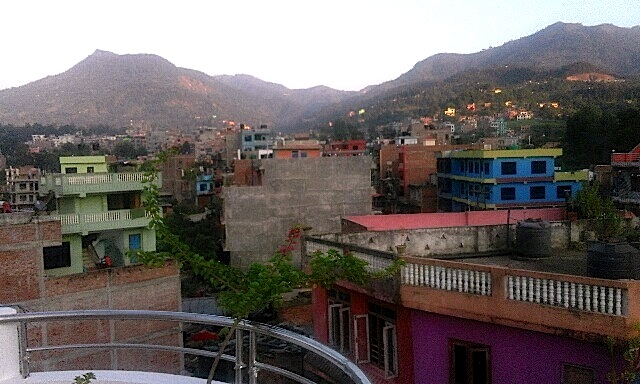
 View from our office roof- Dhading Besi, Government District headquarters, Dhading 

I attended the HEAL (Helping EQ affected Livestock) Launch Event at the Radisson on behalf of the UMN Director. This is a USAID funded 90 day program in 5 Districts (inc. Dhading) to help farmers reinstate their livelihoods by providing bulls, improved shed designs, feed & fodder support, Animal Health training and Animal Health camps, etc. 90 days seems recklessly optimistic to me!

8th September


Trip out to Dhading to part of our working area to inspect temporary learning centres (TLCs) in Pida VDC – went with Peter, Bina, Prem  with our new Driver up the hill from Adamghat. I used to go that way to Kiranchowk when I worked with DRMP community forestry programme (until 2002) so it was pleasantly familiar. Once off the road very little has changed except electric lines and people using mobile phones everywhere. 


in Pida VDC

The first TLC was beside the rough road about 30 mins drive – the road needs repairing after the monsoon rains - we could plan to do this through a Cash for Work scheme which will provide some income for local people and at the same time improve their access for bringing materials to rebuild their houses.  Met Prayas staff (the local NGO Partner we are working with) and school teachers in Head’s office-very hot and dusty! They have  employed a Sub Overseer and 5 masons to erect 11 TLCs already delivered to Pida. These were made in Narayanghat (South Nepal on the Indian border); they are bolted together made with tubular steel instead of box – just need to split the roof trusses for easier portering. We also intend to provide materials for flooring/walling, etc then they will be more permanent.  Altogether we are planning to provide over 40 TLCs in this area, where most of the school buildings have been destroyed.

We were going to have our food higher up - but no veg and a local chicken would have cost a thousand rupees, which is the equivalent of 2 days pay for a labourer!  Eventually the road became impassable so we walked the last hour to a Chepang community for another TLC inspection – very poor community and most houses damaged or destroyed. Noticed they’d used lots of red mud and only a few large crossing stones to anchor the wall together. The school toilets and other buildings were also damaged and their water source needs repairs – they are now carrying water from the river 1 hr’s walk away. The women’s group gave us such a warm welcome adorning us with malas/tikas (garlands and red spots on our forehead) and were all dressed in red. The school teacher recognised me from my time with DRMP – she used to work in the Gobar (methane ) gas office and we often ate together in Gajeri! 


14th September

 Another Bandh (national strike) today relating to the draft Constitution, very pleasant cycling to the office on the quiet roads but not good for schools, businesses and offices of course. Discussed contracting some WASH/sanitation work to another NGO called Shanti Nepal who already work in all our VDCs (local councils) and have good local relations. One of Shanti’s Donors is Tearfund Australia who is also funding part of our programme, so we are looking into sub contracting some activities.

Training and Orientation activities

These have included: Training of Trainers – Trauma Healing (Kathmandu); Conflict Resolution Training (I attended - Dhading -2nd week Oct); 2 days of UMN orientation for all the staff who we have hired so far. It was good that they could all spend some time together before starting work properly. Overall I think we’ve got some good people but it will take time for them to gel as a team.

21st September

This was declared a National holiday to celebrate the signing of the Constitution (finally after 7 yrs in preparation) so we had to reschedule our orientation – this often happens with strikes, festivals etc! Some smaller political parties, such as Hindu Nationalists/Madheshies are not happy - it looks like there will be trouble on the Terai/Far West for a while, but Ktm quiet and v pleasant for a change. UMN was also closed but Jaap and I went in to continue the shortlisting and prepare for interviewing potential new staff. 

Several tons of wheat seed and seasonal vegetable seeds have been distributed as well as agricultural tools ready for the planting season to the North of Dhading nearer the earthquake epicentre, where 90% of houses have been destroyed, which resulted in them also losing their seed for planting. By the end of November as part of the winterisation programme we will be distributing two blankets and one mattress to all 4,000 households in North Dhading before the coldest weather sets in as most people are surviving in temporary shelters.

The third week of September Rachel and I went to Pokhara, at the foot of the Annapurna mountains, for a short break which was lovely and a much needed rest. It was interesting to see the countryside after such a long time and see the much increased forest – partly the result of the community forestry programme I worked with in Dhading until 2002. Now all that is threatened by the need for fuel and building materials.  Fuel is now in very short supply since India closed the border because Nepal would not concede to their demands for the Terai region, which is causing serious problems for everyone. If it continues the whole country will grind to a halt just when we were hoping to start rebuilding. The main Hindu festival Deshain will start next week which will delay things again.


 I’m planning to go trekking with Peter Lockwood (construction engineer) and his boys to North Dhading over Deshain, which should be interesting to see our working area in the shadow of Ganesh Himal  - and hopefully pleasant even if it will be very basic living for a few days just sleeping on local people’s verandahs! This will all take my mind off Rachel being away for a month to celebrate her Mum’s 90th birthday with the family! It is a lot quieter in Kathmandu in her absence but our new friends have been looking out for me and so I have dutifully joined them to support their beloved Ireland in the Rugby World Cup!


Saturday, 19 September 2015

Living with disability in Nepal - Kamala's story

Bear with me – a bit longer post this time as I have included Kamala’s story which she is happy to share; it provides a stark account of living with disability as a marginalized woman in Nepal. 

One of the three small Nepali organisations I am working with is NIDA (Nepal Indigenous People with Disabilities Association). They are a small group of passionate activists representing the most disadvantaged disabled people in Nepal, from the least powerful ethnic minority groups. For the last few weeks it has been a very moving experience to sit with some of the members of NIDA to listen to and write about their issues and their stories. My first task has been to help them prepare a submission to the UN Special Rapporteur for Disabilities on the right of persons with disabilities to participate in decision-making, which is being collected from all countries.


                               Members of NIDA I met with this week : photo by consent

Khadgar Magar (man in photo),  the President of NIDA told me:

Ten years ago I suffered a severe spinal injury in a bus accident. For quite some time I refused to accept my disability….this caused me severe psychological trauma and for 3-4 years I never left my room. [in Nepal there is still much stigma and little support for people with disabilities, especially in remote areas]. Because of my background – providing education to kids – my relative challenged me “if you limit yourself to just staying in this room how can you develop yourself? Finally I decided to do something about changing my life. I bought a wheelchair, started writing books and provided education to my Magar (indigenous tribal group) community. 

I went on to join a disability organisation and later I was made General Secretary but even so I faced great discrimination. It seems that based on my indigenous status and my severe disability I was excluded from participation in every decision making process. [most Nepal disability organisations are run by people from the higher caste, more socially powerful groups] I only attended the meeting, signed the minutes and returned home. People would say things like “your disability is too severe…you can’t manage to get to government offices… there is no access”….“because you have such a severe disability you cannot handle the responsibility of the post. I answered them “if you provide for me a disability friendly environment I can do anything.“ I used to travel two and a half hours by wheelchair to the meetings. Finally they made me Vice Chairman but that is a non-post…I would just stand in for the Chairman in his absence and have no part in the decision making process.

In frustration I left that organization and set up NIDA in order to advocate for indigenous persons with disabilities. Our major concerns are related to the different international agreements on disability that the state [Nepal] has ratified but not yet acted upon. This means that our human rights as indigenous disabled people to be properly represented through participation in the relevant policy and decision making processes are not protected.  Since we are not on represented on any policymaking forum, how can we get our voice heard?

NIDA is advocating for people like Kamala.

Kamala’s story


                                                   Photo by consent

I was disabled at birth. My left leg was small like a ball – not naturally formed and one arm is the same. Once, as a very small child I was injured by a thorn whilst walking outside. The wound became infected and I didn’t get treatment as there was no money pay for it – I am from a very poor Tamang (ethnic minority tribal group) family living in a remote rural area.  The wound got worse and worse and eventually it became cancerous.

I was admitted to the first hospital when I was 12 years old but my father disappeared because he could not pay the hospital fees. I also escaped from the hospital. One of my relatives found me and took me to another hospital. Again my Father realized he could not pay the fees and he disappeared again. After that I stayed 2 years in hospital but I had nothing – not even food. I just ate whatever was left over after everyone had eaten and had to accept charity – I was like an orphan. 

I was 14 when I eventually had to have my leg amputated. After I recovered I was provided with a  wheelchair and they said “now you can go home - we will pay for transport.” I had nowhere to go so I had to stay there for another two years. My home is in a steep remote rural area- impossible with a wheelchair to get anywhere and I just couldn’t face my family. Nobody ever came to visit me in hospital, by now my father was dead and my mother didn’t know anything about what had happened to me.

Whilst I was staying at the hospital I met another Nepali woman who had been badly burnt whilst sleeping. She saw my situation and wanted to help me. Her husband was in America and they had some money so she paid for me to get a prosthetic limb. A doctor helped me and took me to the clinic where they make prosthetic limbs. After getting the prosthetic I was able to go back home to my village to my mother’s house.  It was so upsetting for me in my village. People taunted me and made fun of me. Even my mother was so negative towards me saying things like  “what can you do?   - nothing.”  “What sort of a life can you have?” After a year the ‘foot’ part broke. I went back to the same place in Kathmandu to get it mended. The man asked me “have you brought 10,000 rupees?” Of course I didn’t have any money so I just left and tried to manage. that I could barely walk – I used a stick but it was very hard.  

So I finally made the hard decision to come back to Kathmandu and stayed with a relative for a while. I got a job cutting wool for carpet – very, very hard work. Later I got work in an Indian business making necklaces earning 1 rupee [less than one pence] per necklace. I made 100 a day so that was enough to rent a small room. When I was 27 I  met a nice man, able bodied, in the Nepal police and on the  third day I married him! I was so happy to get pregnant but then I was very sick and had a miscarriage at 8 months – this still makes me feel very sad. My husband had to care for me so he lost his job and he is still jobless.

The house where we had a room was destroyed in the earthquake and life is very hard. I cannot read or write because I had no schooling. My husband was an orphaned teenager as his parents were killed in the Maoist conflict. Me and my husband are happy together but from morning to night our life is difficult and we live hand to mouth. My mother used to send grain (rice, maize etc) from the village but in the earthquake her house, field and belongings were all destroyed so now there is nothing. The Indians I worked for have all gone back to India after the earthquake and so again I have no job. For one year now I have had a big problem with my prosthetic leg which is broken and I keep falling over – I just have to keep taping it up. I cannot get it repaired because I cannot pay the fees. 

I don’t know what will come tomorrow……….

Kamala found out that same day that NIDA have, after months of effort, finally managed to find some financial support to help pay for her new prosthetic limb.